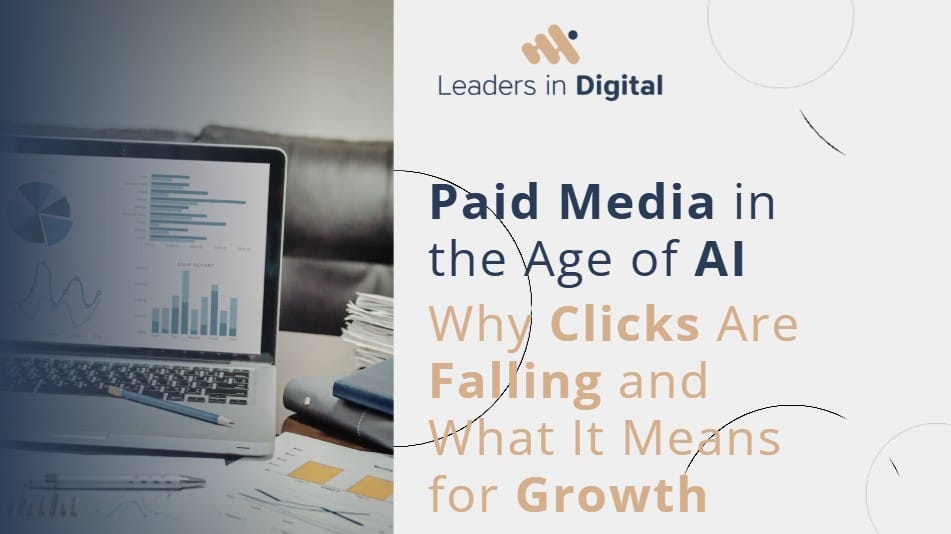
Over the past year, we have been having more detailed conversations with clients about paid media performance. However, the nature of those conversations has changed.
It is no longer only about scaling budgets, improving creatives, or refining targeting. Instead, it is about understanding why results feel different even when campaigns appear to be working.
On paper, performance often looks strong. Impressions remain high. Reach is consistent. Campaigns still deliver visibility across multiple platforms. In some cases, click-through rates have only slightly declined or remained stable, which would normally suggest that engagement is holding.
And yet, outcomes are shifting.
Clicks are lower than expected compared to reach. Conversion journeys are less linear and harder to track. The connection between spend and return feels less immediate, even when campaigns remain active and optimised.
As a result, the first instinct is to question execution:
- Do we need to increase budget?
- Do we need better creative?
- Is the targeting off?
However, when we analyse performance across brands in Dubai and London, across both B2C and B2B sectors, the data points to something more structural.
User behaviour has changed.
The Shift: From Click-Driven to Decision-Driven Behaviour
Paid media has traditionally operated on a clear model: visibility drives clicks, and clicks drive conversions.
That model still exists. However, it no longer reflects the full customer journey.
Users are increasingly exposed to ads but choose not to click immediately. Instead, they move into a second stage where they validate what they have seen.
This often happens through:
- AI search platforms such as ChatGPT
- Brand searches on Google
- Additional comparisons and research
In practice, a user may see an ad, pause, research the brand through AI search, and make a decision without returning to the original ad.
The click is no longer the first action in the journey.
In many cases, it is no longer required at all.
What the Data Is Showing
Recent industry data shows that a large percentage of searches now end without a click. In many sectors, estimates exceed 60%, depending on the device and industry.
At the same time, users are engaging more with answer-based environments where platforms provide information directly without requiring navigation to external websites.
In paid media campaigns, this creates a growing gap between impressions and clicks. Visibility continues to increase, but interaction becomes more selective.
Users are not disengaging.
They are simply making decisions differently.
We are also seeing an increase in brand searches after paid ad exposure. This suggests users prefer to validate brands independently rather than click directly from an ad.
In analytics, this often appears as:
- Direct traffic
- Brand search traffic
- Unassigned conversions
As a result, performance can appear less attributable, even when campaigns create demand.
Why This Creates a Measurement Gap
This shift creates a disconnect between traditional metrics and actual influence.
Paid media may still drive awareness, shape perception, and influence decisions. However, if measurement focuses only on clicks and last-touch attribution, the full impact is missed.
A campaign can generate strong visibility and influence without producing a proportional number of clicks.
Often, that influence appears later in the customer journey through:
- Brand searches
- Direct visits
- Alternative conversion paths
The activity is working.
The way we measure it simply has not evolved fast enough.
What We Are Seeing at Leaders in Digital
At Leaders in Digital, founded by Dawn Kubicek, this shift is changing how we approach paid media strategy across Dubai and London.
We consistently see that campaigns aligned with a broader AI marketing strategy outperform campaigns operating in isolation.
Brands that connect paid media with AI search, content, and overall visibility build stronger pipelines, even when traditional engagement metrics fluctuate.
The difference is not budget size or platform choice.
The difference is strategy alignment.
Why Paid Media Now Needs an AI Marketing Strategy
Paid media can no longer operate as a standalone channel focused only on clicks and conversions.
Instead, it must become part of a wider AI marketing strategy that reflects how users now behave across platforms.
Every ad impression now creates a secondary effect. It drives curiosity, encourages validation, and often leads users into AI search environments where they assess your brand.
An effective AI marketing strategy ensures that:
- Your ads align with how AI platforms describe your brand
- Your messaging remains consistent across paid and organic channels
- Your website reinforces the positioning users already expect
- Your visibility extends beyond the ad itself
Without this alignment, paid media generates interest but struggles to convert that interest into action.
The Role of the LiD AI Visibility System
This is where the Leaders in Digital AI Visibility System becomes critical.
The system ensures your brand is not only seen, but also recognised and trusted throughout the customer journey.
Within this system:
- Paid media drives awareness
- AI search reinforces credibility
- Content and PR create consistent signals
- Your website confirms and converts decisions
Each element supports the others.
Together, they create a connected loop of visibility, trust, and conversion.
This is the difference between simply running campaigns and building a visibility system.
What Needs to Change
The shift is not about abandoning paid media.
It is about evolving how brands use it.
Brands must move from a click-focused mindset to a visibility-focused one. Success can no longer rely only on immediate interactions.
Instead, brands must measure how effectively paid media contributes to the wider decision-making process.
This requires:
- Aligning paid media with AI search behaviour
- Creating consistency across all brand touchpoints
- Expanding measurement beyond last-click attribution
- Ensuring visibility wherever users validate decisions
Because paid media no longer operates only at the point of action.
It operates at the point of influence.
Final Thought
Clicks still matter, but they are no longer the centre of the customer journey.
Brands that optimise only for clicks will struggle to explain performance over time. Meanwhile, brands that understand how AI search and user behaviour are evolving will create stronger and more predictable growth.
Paid media has not become less effective.
It has become more connected.
If your paid media performance feels inconsistent, or the relationship between spend and results feels harder to interpret, it may not simply be a campaign issue.
It may be a visibility issue.
At Leaders in Digital, we help brands across Dubai and London build AI marketing strategies and AI Visibility Systems that connect paid media, AI search, and digital presence into one aligned ecosystem.
If you want to understand how your paid media fits into this new environment, you can:
- Book a Leaders in Digital AI Visibility Executive Session
- Request an AI Visibility Audit